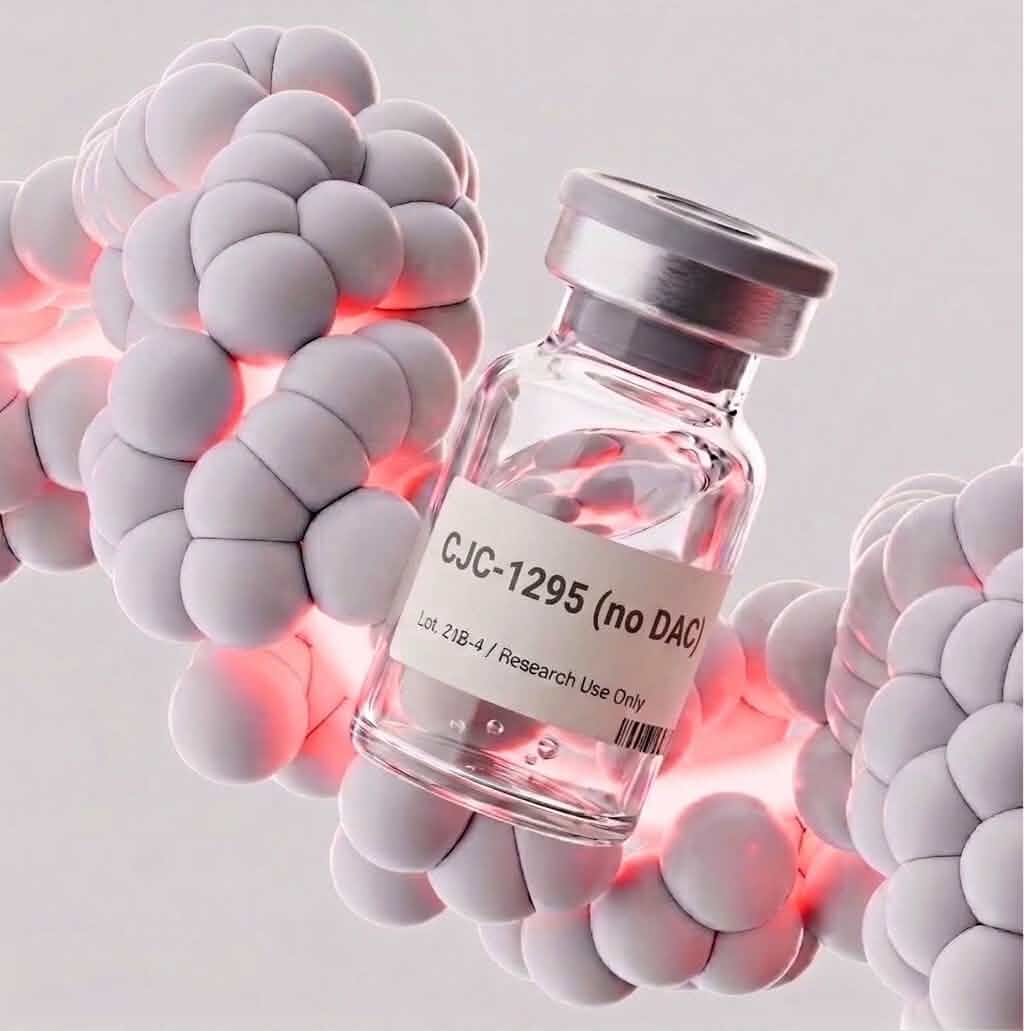
Research Profile
CJC-1295 is a synthetic 30-AA GHRH(1-29) analogue with four amino acid substitutions conferring DPP-4 resistance. Two variants: No DAC (half-life ~30 min; pulsatile GH release; daily dosing) and With DAC (albumin-binding maleimide group on Lys-30; half-life ~6–8 days; weekly dosing, continuous GH elevation).
Single CJC-1295 injection produced 2–10× GH elevation for 6+ days and 1.5–3× IGF-1 for 9–11 days in 65 healthy adults (Teichman 2006). No DAC is preferred for preserving physiological pulse architecture.
Note on DAC: continuous GH elevation from the DAC variant may blunt natural pulsatile architecture important for anabolic and lipolytic signalling. Most protocols prefer No DAC combined with Ipamorelin.
GH axis restoration — works upstream, stimulating the pituitary's own somatotrophs. Somatostatin feedback preserved — no supraphysiologic spikes unlike direct GH injection.
Body composition — elevated GH/IGF-1 drives lean mass accretion, visceral lipolysis, protein synthesis. Active research in sarcopenia and age-related body composition decline.
Sleep architecture — GH secretion coupled to slow-wave sleep. Pre-sleep CJC-1295 + Ipamorelin amplifies natural GH pulse during SWS. Relevant in ageing populations where both SWS and GH decline in parallel.
Anti-ageing — IGF-1 mediates cellular repair, collagen synthesis, bone turnover. GH axis declines ~14%/decade after age 30; secretagogue research aims to restore youthful pulsatility.
Synergy with Ipamorelin — GHRH receptor (CJC-1295) + ghrelin receptor (Ipamorelin) → synergistic GH pulse exceeding either compound alone.
No DAC preferred for preserving pulsatile architecture. Inject fasted — insulin suppresses GH response. Pre-sleep injection amplifies natural SWS GH pulse. Standard stack: CJC-1295 No DAC 100 mcg + Ipamorelin 200–300 mcg, 5 days/week, 12–16 week cycles with 4-week rest.